All posts in the ‘Products’ category

Subscribe to the RSS feed for the 'Products' category

Change Moom’s keyboard/grid bezel timeout delay

Thursday, October 30th, 2014

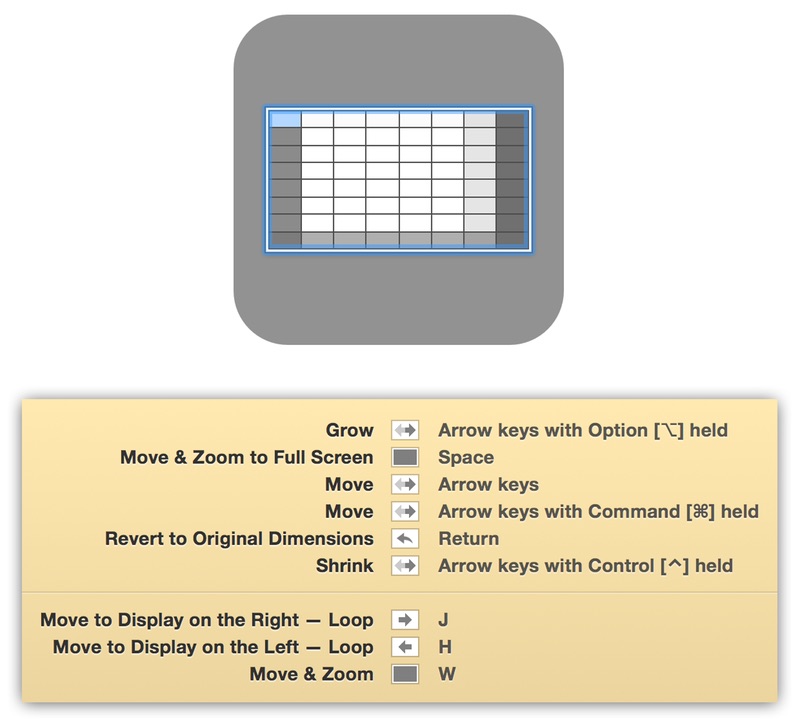
One of Moom’s tricks is the ability to move and zoom windows via an onscreen bezel—this feature is enabled in Moom’s Keyboard preferences; assign a hot key to display the keyboard controller, and optionally show a cheat sheet (to help remember the commands you’ve assigned). You can also optionally repeat the same keystroke to have Moom display an onscreen grid.

As an example, here’s the onscreen grid with cheat sheet:

Moom's onscreen grid

Moom’s onscreen bezels automatically disappear after either three seconds (no cheat sheet visible) or nine seconds (cheat sheet visible)—either after taking an action (if you haven’t marked any of the “auto-dismiss” boxes in the Keyboard section of Moom’s prefs) or after doing nothing.

If you’d like to change this, you can. Open Terminal—in Applications > Utilities—then paste the following into Terminal. (Note that if you’re on OS X 10.8 or earlier, you need to quit Moom first.)

defaults write com.manytricks.Moom "Auto-Deactivate Interval" -float 1.0

The 1.0 is the default timeout in seconds; replace that with whatever time interval you’d like to use, then press Return. You won’t see any output, but relaunch Moom, and the bezels should follow your chosen auto-dismiss interval. If you ever want to reverse this, quit Moom, paste the following in Terminal, and press Return:

defaults delete com.manytricks.Moom "Auto-Deactivate Interval"

Moom should now be back to its default timeout settings.

Our apps and OS X 10.10 (Yosemite) compatibility

Sunday, October 19th, 2014

Now that OS X 10.10 (aka Yosemite) is officially out, here’s a status report on our apps. The short version: they all work fine, with some minor visual oddities here and there.

Primary applications

Our primary apps—Butler, Desktop Curtain, Keymo, Leech, Moom, Name Mangler, Time Sink, Usher, and Witch—are all compatible with Yosemite.

Some of these apps have some cosmetic issues we’ll be addressing via updates in the near future, but they’re relatively minor adjustments. We’re also working on finding a solution for a Yosemite issue that’s affecting some Witch users.

Baubleries and Safari extensions

The following run without any issues: Key Codes, as well as our two Safari extension (⌘-Click Avenger and Unread→Tabs).

We do not recommend the use of Open-With Manager, Safari Guardian, or Service Scrubber on Yosemite (or more generally, any release newer than Mac OS X 10.5).

Displaperture and Menu Bar Tint: Both of these apps need to be re-signed for Yosemite, and we will do so in a future update. Until then, to run them you’ll need to manually allow each to run in the Security & Privacy System Preferences panel—on the General tab.

You can either change the “Allow apps downloaded from” pop-up to Anywhere, or click the button you’ll see that asks you if it’s OK to run the apps, even though they’re from unidentified developers. (You’ll see this button after trying to run the app once.)

Overall, the upgrade to Yosemite should be a fairly painless one for users of any of our applications.

You want updates? We got updates!

Wednesday, August 6th, 2014

Today, we’re releasing updates to nearly every app in our collection: Butler, Desktop Curtain, Key Codes, Keymo, Leech, Moom, Name Mangler, Time Sink, Usher, and Witch.

Why the massive update day? First off, a few of the apps have some Yosemite appearance changes (any of the apps that have a menu bar icon, for instance)—and we know at least some of you are using the Yosemite preview. So that’s one cause for the massive number of updates. But not the main cause.

The main cause is that Apple is changing the rules for Gatekeeper in the upcoming OS X 10.9.5 (and obviously in Yosemite as well). This change, as discussed on The Mac Observer, could cause many apps (including ours) to warn users about running insecure software. (Our apps are not insecure, but the change in Gatekeper would make it look like they are.)

Because of the unknown release date for 10.9.5, we’ve taken the unusual step of releasing our direct version updates today, before the App Store versions are ready to go. We’ve submitted the App Store updates to Apple, but given the Gatekeeper change and the huge number of apps that need to be reapproved, we don’t know how long approvals will take.

If you’re a direct customer, you can get updates via in-app updating, or by downloading a new version from our web site. Our App Store updates are marked to release automatically, as soon as Apple approves them. As each is approved, we’ll do our best to note it on Twitter, so that you can get the updates as soon as possible.

For full details on any app’s update, go to that app’s page, then click on Release Notes (e.g., Moom’s release notes).

How to: Discover the magic of the sequence identifier

Monday, May 19th, 2014

One of the main features in Name Mangler 3 is multi-step renaming. Instead of being limited to just one renaming step, you can add many steps to one renaming task. In prior versions of Name Mangler, you’d need to use Advanced mode, or run multiple repeated single tasks, to handle multi-step renaming tasks. This is a great change for everyone, and has greatly reduced the need to use Advanced mode.

But Name Mangler 3’s Advanced mode still has a few tricks that you can’t do using the “normal” renaming options. One of the most powerful of these hidden gems is the “sequence identifier” parameter for the sequence action. The help file has this to say about the sequence identifier:

The sequence identifier, if included, indicates that sequence indexes are only inferred from the number of files that share the same identifier, as opposed to the overall number of files to be renamed.

Clear as mud, right? That’s entirely my fault, and I’ll try to come up with better wording in a future update. But for now, here’s a hopefully-clearer description:

The sequence identifier, if included, is used to group files together (by a common criteria) for sequencing. All files that share a sequence identifier will be treated as part of the same sequence.

Hopefully that’s a bit clearer…and here’s a real-world example of how you can put sequence identifiers to use to simplify your renaming tasks.

(more…)

Butler 4.1.17 released

Tuesday, May 13th, 2014

Today we released a minor Butler update, with three small but important bug fixes:

  • Keystrokes Smart Items now let you use the current pasteboard via cmd-v keystroke, provided that you add a sufficiently long delay (recommended: 1 second) in front of the cmd-v keystroke.
  • Fixed a display glitch where delays in Keystrokes Smart Items weren’t displayed properly.
  • Fixed an issue with the Screensaver Smart Item.

You can update within Butler (in the About Butler section of its configuration window), or by downloading the full version from our site.

How-to: Replace preference files in Mavericks

Thursday, January 30th, 2014

Something many people do, myself included, is copy an application’s preferences file—either from one Mac to another (as a quick way of getting an app configured to my liking) or to replace a damaged/lost preferences file using a Time Machine backup. Until recently, this process was really simple: quit the app in question, trash the existing prefs file, insert the new prefs file, launch app.

Enter OS X 10.9, aka Mavericks, aka “the easy prefs copy killer.” Apple has made changes to the way the preferences system works in Mavericks, and one casualty of those changes is the easy replacement of an application’s preferences file. A brief bit of before-and-after, and then we’ll get to the fix—or just click the Read More link to jump right to the fix.

In prior versions of OS X, preferences files were always read by the application at launch. So as long as the app wasn’t running, if you replaced its preference file, it would read the new file the next time you launched the program.

In Mavericks, preferences are managed by a background daemon, cfprefsd. This service reads the preferences file once, when you first run the app. It then (I believe) receives notifications if you change the program’s settings while the program is running, and then writes them to the actual preferences file at certain points in time. But cfprefsd always has a copy of those settings in its cache, and that’s what the app gets when it checks its settings. (This reduces hard disk access, which is important in conserving battery life in laptops.)

Here’s the important bit: After you’ve launched an app once, it seems that any subsequent launches also get their preferences from cfprefsd. So if you try the old “replace the prefs while the app isn’t running” trick, you’ll be quite surprised to find that your program launches with its previous settings. It will do this even if you simply delete (via Finder) the old prefs file!

So how do you get around this aggressive caching of preference files?

(more…)

Usher’s App Store hiatus is over

Thursday, January 23rd, 2014

After much back-and-forth with Apple, we’re thrilled to announce that Usher 1.1.8 has been approved for sale in the App Store! Version 1.1.8 is basically the same as the recently-released 1.1.7, with a few additional bug fixes. Both the direct and App Store versions of Usher are now at 1.1.8, and both are available at the lower $25 ($24.99 App Store) price.

Direct buyers can get the update via in-app updating; App Store buyers should see the update in the App Store application shortly, if not already. (If you’re having trouble finding Usher in the App Store, it seems that Usher’s hiatus has caused some difficulty with search. Try this direct link instead.)

We’re sorry we had to (briefly) take Usher out of the App Store, but we didn’t feel right selling it with usability issues in OS X 10.9. But now, it’s back, and at feature parity with the direct sales version.

Ushering in some changes in Usher

Monday, December 2nd, 2013

Today we’re releasing Usher 1.1.7, but before upgrading, you should read this entire blog post, so you understand what’s happening with Usher going forward.

IMPORTANT NOTE: The minimum system requirement for Usher 1.1.7 is OS X 10.7 or newer; if you’re still running 10.6, DO NOT INSTALL THESE UPDATES. You can download older versions on our support page.

Why 10.7 or newer? Apple recently declared an old security-related API dead (i.e. deprecated), and recommended that all developers switch to the newer API, which we did. But that new API requires 10.7 or newer.

First up, in case you missed it, Usher is not presently available on the App Store. This change may be temporary (if we can resolve some issues with Apple), or it may be permanent (at least for this major version of Usher).

Second, Usher’s new price is $25 (on our site only, for now), down from $35. Why drop the price? Partly because we’d like more people to give Usher a look. But primarily because this version removes the ability to download videos from YouTube and Vimeo. Why did we remove this feature?

(more…)

Usher has gone on an App Store hiatus

Thursday, November 28th, 2013

As of today, the App Store version of Usher is no longer available for purchase. It may reappear in the future, if we can resolve some issues with the App Store. For now, though, we have removed it from sale.

Why did we do this, and what does this mean for App Store buyers?
(more…)

How-to: Start and stop Leech on a schedule

Tuesday, November 26th, 2013

Note: This article applies to Leech 2; Leech 3 has built-in scheduling support.

One feature that Leech, our simple download assistant, doesn’t offer is scheduling. For many users, this isn’t an issue, as they can use their internet connection whenever they wish. There is a subset of users, though, who have internet connections that may offer more speed at night, or not have capacity limits at night, or may allow unlimited downloading only at night.

A future version of Leech may offer scheduling, but until that comes to be, you can use AppleScript and a scheduling application to handle the task. It’s not overly complicated, but does require a bit of work in Leech and AppleScript.

The first step is to have Leech queue up all download requests, so you can just copy and paste URLs into it during the day, then let it run at night. To put Leech in queued mode, just make sure there’s not a checkmark by the Queue > Start Downloads Automatically menu item, as seen in the image at right.

Once that’s done, you can add URLs to Leech throughout the day, but they won’t start downloading. Next, you’ll need to create two AppleScripts, one to start those queued downloads, and the other to pause them again.
(more…)